TERRAIN AND CLIMATE
Terrain
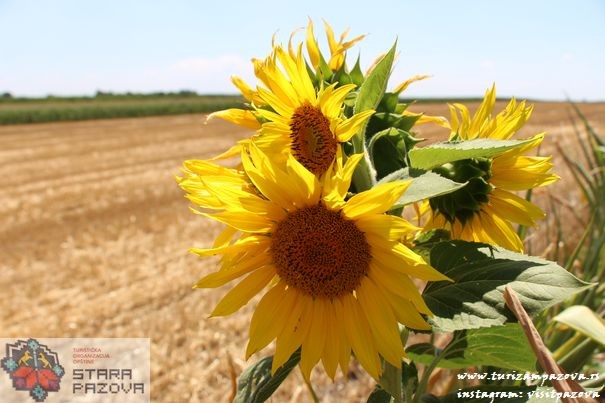
The terrain of the municipality of Stara Pazova had been created by the action of tectonic movements and the mechanism of exogenous forces. All three terrain units – the loess plateaux, loess terraces and alluvial plane – have been created by the mutual action of all aforementioned geomorphologic factors.
The loess plateauxare clearly separated from the alluvial plain of the Danube by a high section. It slightly decreases towards the west and turns into the loess terrace without a clearly defined boundary.
The loess terrace occupies the southwestern part of the municipality. The boundary to the higher loess plateau is poorly expressed. In its southern parts, the frequent forms of the fossil flows are clogged with loess.
The alluvial plain of the Danube occupies a narrow strip of the land to the east, between the riverbeds and the high loess section. The three Danube river islands belong to it as well.
Climate

In the municipality of Stara Pazova there is a moderate-continental climate with clearly distinguished seasons and a great temperature variability. The summers are warm and predominantly dry, winters are cold with snow, while spring and autumn have a warmer weather with large amounts of precipitation. The coldest month with the lowest temperatures is January, with an average temperature of -1°C. The hottest month of the year is July, with an average temperature of 21.6°C.
FLORA AND FAUNA

In the municipality of Stara Pazova, the natural vegetation occupies very small areas. The most common woody plants in our area are maple, elm, acacia, birch, elder, willow, linden and poplar. Forest vegetation covers only 4 km2, while meadows, pastures and marshy wetland vegetation occupy almost 8 km2. The dominant landscapes on the territory of this municipality are arable lands and other agricultural areas. Free areas with natural vegetation cover the alluvial plain of the Danube, a loess plateau and a loess terrace. The entire alluvial plain is under a wild vegetation. It is made up mostly of the willow and poplar forests, while in the valley of Budoar there are the groves of acacia or willow.
There is only one protected monument of nature in the municipality of Stara Pazova. It is the tree of white poplar near Stara Pazova, which is a very beautiful and developed specimen of its kind. This monument of nature is located next to the regional road R-106, that goes from Stara Pazova to Stari Banovci. The animal world is also poor. The scarce plant world does not encourage wildlife and other animal species. Regarding the game, there are rabbits, roe deer and pheasants, which are less likely to meet along the roads, and more often in the arable land and in the area of the alluvial plain of the Danube.
THE DANUBE

After the Volga river, the Danube is the second largest river in Europe that occupies the 33rd position in the world. It springs at the foot of the Schwarzwald Mountain in the southwestern Germany, which is the place where the Breg and Brigah rivers join at the German town Donaueschingen. Along its course it passes through 10 countries: Germany, Austria, Slovakia, Hungary, Croatia, Serbia, Romania, Bulgaria, Moldova and Ukraine. The length of the Danube from its source to the mouth, in the form of a delta in the Black Sea, is 2850 km. The Danube River represents a very important transport corridor called the Pan- European transport corridor VII. The Danube, as a navigable river, flows through Serbia at a length of 588 km from Bezdan to Prahovo. It passes through 22 towns and municipalities in Serbia, and in this region live almost a million inhabitants of our country.
The Danube river basin (Podunavlje) includes four settlements that follow the Danube stream from the direction of Novi Sad, continuing to Stari Slankamen, i.e. Surduk, Belegiš, Stari Banovci and Novi Banovci. The Danube coast is not only untouched but also authentic, with a picturesque landscape with loess sections, inlets, cafes and beaches. It has all the advantages and benefits for enjoying the beauty and magic of this beautiful large river.
ARCHAEOLOGICAL SITES
Settlements in Ancient history and Early middle ages

The important research carried out by the archaeologist Dr Dušan Popović (1994) showed that the most powerful forts were on the Danube in Surduk, Belegiš and Novi Banovci. They later evolved into Celtic opida and Roman castra. On the territory of the municipality of Stara Pazova, these prehistoric sites with settlements were located in the Danube valley, at the sites of Belegiš (Šančine, Gradac i Jugovićev breg), Novi Banovci (Gradina or Purger), Surduk (Gradina) and Stari Banovci (Beli breg ).
The period of prehistory ended with the arrival of the Romans in the middle of the 1st century BC. In the beginning, from the 3rd and 4th century AD, the interests of the Romans were exclusively military-strategic. In addition to the aforementioned, they built military fortifications, raised entire cities, built roads, hydromelioration channels and bridges. They were engaged in agriculture, cultivated vineyards and built spas and health resorts. In order to protect the line of the northern boundaries of the empire and consolidate the position along the province of Pannonia, they formed numerous fortifications in the Srem region that protected them from the fall of the barbarians. Thus, on the right bank of the Danube, the following Roman cities were established on the territory of the municipality of Stara Pazova: Burgenae (Novi Banovci) and Rittium (Surduk). Both castra represented the important links in the chain of defensive fortresses on the border.